Mark Minevich is a digital cognitive AI strategist and a President and founding partner of Going Global Ventures. He is also a co-founder and co-chair of AI for Planet Alliance[…]
Search Results
You searched for: Mark M
Mark P. Mills is a senior fellow at the Manhattan Institute and a faculty fellow at Northwestern University’s McCormick School of Engineering and Applied Science, where he co-directs an Institute[…]
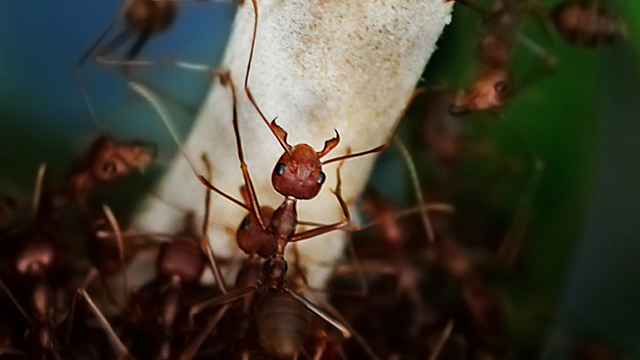
Mark Moffett is a entomologist, nature photographer and explorer. He received his PhD at Harvard University, studying marauder ants with renowned insect scientist Edward O. Wilson, and is currently a[…]
Entomologist and National Geographic writer/photographer Mark Moffett knows a lot about bugs. Having studied marauder ants under renowned insect biologist Edward O. Wilson at Harvard, and then gone on to […]
Mark McKinnon was the genius behind Bush’s 2004 media strategy. The Bush campaign successfully portrayed Bush as “a strong leader in a time of change” while redefining Kerry as “weak, […]
Entomologist Mark Moffett stopped by the Big Think offices today to share a few lessons that he’s gleaned from his work studying ant societies and his time as a nature […]
John Amaechi’s journey from British bookworm to NBA player and organizational psychologist reveals that high performance requires vision, grit, and the recognition that success is often a collective effort rather than an individual achievement.
Mark Johnston is Professor and Chair of the Department of Biochemistry and Molecular Genetics at the University of Colorado School of Medicine and Editor-in-Chief of the journal Genetics. Fields and[…]
Welcome to The Nightcrawler — a weekly newsletter from Eric Markowitz covering tech, innovation, and long-term thinking.
Mark Weinstein is a tech entrepreneur, thought leader, privacy expert, and one of the pioneers of social networking. He is the author of Restoring Our Sanity Online: A Revolutionary Social Framework.
Welcome to The Nightcrawler — a weekly newsletter from Eric Markowitz covering tech, innovation, and long-term thinking.
The best of all investor attributes is easily attained — and unbeatable in combination with other advantages.
Mark Freeman is the Distinguished Professor of Ethics and Society in the Department of Psychology at the College of the Holy Cross. His books include Rewriting the Self: History, Memory, Narrative and Hindsight:[…]
Eric Markowitz is a partner and the Director of Research at investment firm Nightview Capital. A former investigative journalist, with bylines in The New Yorker, GQ, Fast Company, among other[…]
Ditch the old brain vs. heart assumptions, and instead think about a heart-led brain.
Mark Bateman is CEO of development network, WeQual, and the author of Disruptive Leadership.
How to juggle while walking a tightrope — at work.
The innovative investor and entrepreneur deals out advice for anyone looking to follow in his footsteps.
Mark Cuban is an American entrepreneur worth over $4 billion whose pioneering dot-com startups led him to early success before he ventured into sports as the owner of the NBA's[…]
What if AI could tell us we have cancer before we show a single symptom? Steve Quake, head of science at the Chan Zuckerberg Initiative, explains how AI can revolutionize science.
▸
5 min
—
with
It has already been trialed in people and could give us a better way to analyze and stimulate the brain.
It’s not just fun: DNA origami has the potential to revolutionize engineering at the nanoscopic scale.
In war zones, aggressors steal art to eradicate the cultural heritage of others. Victims, meanwhile, sell stolen art in order to survive.
Mark Esposito is Professor of Business & Economics at Hult International Business School, where he directs the Futures Impact Lab. He is co-author of The AI Republic and The Great Remobilization.
As the stream of AI-generated art turns into a deluge, NFTs could become a cornerstone of the Virtual Renaissance.
If a court needs to know if two trademarks look too similar to each other, perhaps the jury should be given a brain scan.
Mark Quigley, Associate Professor of Earthquake Science, The University of Melbourne