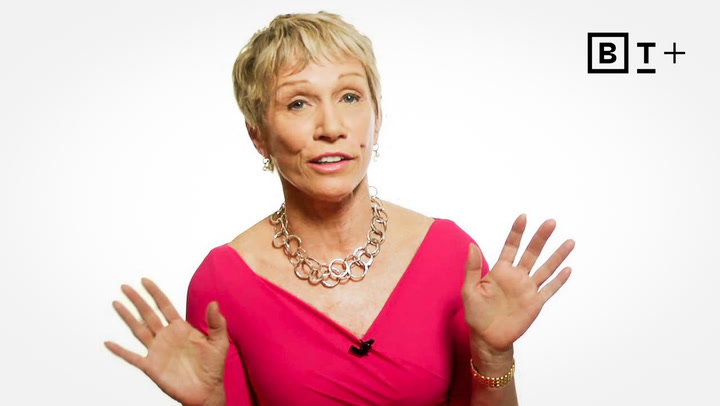
On Shark Tank, Barbara Corcoran emphasizes that strong pitches come from well-prepared, confident presenters who anticipate questions and dress appropriately, while weak pitches often stem from overcomplicated jargon and unprofessional appearances that undermine credibility.
Oops! That page can’t be found.
It looks like nothing was found at this location. Maybe try a search?
Were you looking for something like this?
Debbie Millman emphasizes that courage is essential for building confidence and resilience, arguing that true bravery lies in overcoming fear and taking risks, as regret from inaction is far more detrimental than the potential for failure.
This class, featuring insights from experts like Amy Cuddy and Sylvia Ann Hewlett, explores the concept of presence in communication and leadership, offering strategies to enhance executive presence, build confidence, and effectively manage performance anxiety for professional success.
To communicate effectively in a crisis, understand the emotions involved, provide reassurance and transparency, acknowledge mistakes, and demonstrate competence to build trust throughout the acute, response, and post-disaster phases.
Salespeople should build trust with clients by being honest about their company’s limitations, offering custom solutions or even referring them to competitors, while also relaying client needs to leadership for potential future development.
Confidence is essential for success, but it should be rooted in embracing uncertainty and open-mindedness rather than certainty, as this fosters better decision-making, collaboration, and adaptability to new information.
Humor is a powerful tool for connection and communication, and by analyzing what makes you laugh and gauging audience reactions, you can refine your comedic approach to ensure it resonates effectively.
Salman Rushdie emphasizes that to become your best self, embrace lifelong growth through experience and constructive criticism, protect your creative work until it’s ready for feedback, and maintain your unique voice while building confidence despite differing tastes.
This class features insights from Salman Rushdie, Annie Duke, and Matt Dixon on authenticity, confidence, and effective communication, emphasizing lifelong growth, the importance of embracing uncertainty, building trust in client relationships, and navigating crises with clarity to enhance leadership skills.
Lisa Lampanelli’s career in stand-up comedy reveals guiding principles for connecting with any audience, emphasizing the importance of servant leadership, impactful storytelling, authenticity, and finding your unique voice through personal experiences and passions.
This class, led by experts like Lisa Lampanelli and Amy Cuddy, teaches essential communication skills for authentic audience connection, focusing on storytelling, self-awareness, and adapting to diverse perspectives in today’s multicultural workplace.
Jack D. Hidary, an entrepreneur in finance and technology focused on clean energy, shares strategies for maximizing serendipity through in-person networking, conference crashing, and online engagement to enhance value and foster innovation.
This class teaches participants to actively engineer professional networks for career development, offering strategies from experts like Christakis, Hidary, and Grant to build meaningful connections, leverage social dynamics, and foster mutually beneficial relationships.
Bazerman’s bounded ethicality highlights how ordinary psychological processes can lead good people to unknowingly engage in unethical behavior, as illustrated by the Challenger tragedy, emphasizing the need for heightened awareness, firm ethical grounding, and thorough consideration of data omissions in decision-making.
Cultural assumptions, often perceived as common sense, can lead to misunderstandings in international relations; thus, David Kang emphasizes the importance of questioning these biases, particularly Eurocentrism, and integrating local knowledge to better understand Asia’s diverse perspectives and trends.
To navigate workplace challenges effectively, adopt a historian’s approach by recognizing familiar patterns, critically assessing diverse perspectives, and viewing issues within a broader temporal context to maintain perspective and avoid being swayed by immediate rhetoric.
The CIA’s “Red Team” during the Cold War exemplified strategic empathy by encouraging high-ranking officers to role-play adversaries, fostering humility and curiosity to enhance understanding and inform leadership decisions through an unorthodox analysis of emotions and perspectives.
This course on strategic empathy, led by instructors like Amaryllis Fox and Liv Boeree, teaches participants to understand opposing viewpoints through “Red Teaming,” while addressing cognitive biases and emphasizing the importance of historical context, cultural awareness, and ethical decision-making in complex global issues.
In this video lesson, theoretical physicist Leonard Mlodinow illustrates how elastic thinking can transform problem-solving by encouraging a flexible approach that challenges initial strategies and explores underlying principles governing the issue at hand.
Guru Madhavan emphasizes that while constraints are inevitable, effective problem-solving requires a systems-level perspective that balances specialized skills with resource efficiency, urging individuals to continually question failures to drive improvement.
Despite ancient Greek knowledge of a round Earth, many still believe in a flat planet due to a human predisposition for magical thinking, making it challenging to combat superstition and conspiracy theories even with evidence and reason.
This class explores human cognition and decision-making through insights from experts like Michio Kaku on magical thinking, Madhavan on systems-level thinking, Mlodinow on elastic thinking, Konnikova on deductive reasoning, and Summers on structured decision-making, promoting a scientific mindset for effective problem-solving.
Emma Seppälä from Stanford highlights that our best ideas often emerge during moments of rest, suggesting that scheduling regular breaks can enhance creativity and productivity, especially in a work culture that undervalues time off.
Flow is an optimized state of performance achieved through a four-part cycle—struggle, release, flow, and recovery—where understanding and managing each phase, particularly struggle and recovery, enhances your ability to access flow more frequently.
Neuroscientist Amishi Jha emphasizes that cultivating meta-awareness—being conscious of your thoughts and emotions—can help you navigate distractions in today’s VUCA environments and regain control over your attention amidst the challenges posed by technology and constant information bombardment.
Willpower, governed by the brain’s frontal cortex, can diminish due to low energy from factors like low blood sugar, stress, and lack of sleep, leading to issues like distraction and impulsivity; thus, understanding these biological influences is key to enhancing productivity.
This class explores the link between neurobiology and productivity, teaching participants to optimize willpower and focus through strategies like meta-awareness, the Pomodoro Technique, and the importance of rest, while experts share insights on achieving peak performance amidst modern distractions.
A childhood spent under the spell of sleight-of-hand taught me skepticism, curiosity, and the habit of looking beneath appearances.
Big Think spoke with astronomer David Kipping about technosignatures, “extragalactic SETI,” and being a popular science communicator in the YouTube age.
In this excerpt from “Seven Rivers,” historian Vanessa Taylor explores how Ancient Egyptian pharaohs harnessed the Nile River to build empires and secure their power.