 Learning & Development
Develop leaders in your organization with Big Think+ classes
Learning & Development
Develop leaders in your organization with Big Think+ classes
 Custom Content
Create premium thought leadership and storytelling with Big Think Creative
Custom Content
Create premium thought leadership and storytelling with Big Think Creative
 Advertising Campaigns
Reach the smartest audience on the Internet with Big Think editorial integrations
Advertising Campaigns
Reach the smartest audience on the Internet with Big Think editorial integrations
 Live Events
Bring your people and ideas to life with Big Think Events
Live Events
Bring your people and ideas to life with Big Think Events
This content is locked. Please login or become a member.

Create disfluency
For years Cincinnati had a problem with underperforming schools. And for a long time, they didn’t understand why this problem existed because Cincinnati has long been at the forefront of the big data revolution. They would collect every fact and figure they could about students. They would process that into these really pretty reports and graphs that they would send to teachers. And yet for some reason, it didn’t seem to change how teachers were acting in the classrooms. It didn’t seem to improve the city’s schools.
So a couple of years ago the city decided to do something a little bit different. Instead of taking all of this data and making it really easy to absorb, they did exactly the opposite. They told a bunch of teachers that they had to go into these rooms, these old closets that they had called data rooms, and that rather than just getting printouts of students’ scores they needed to transcribe those scores by hand onto index cards. And then they had to make piles of those index cards to try and figure out who was doing well on certain questions and who was falling behind on math or grammar. And they had to make graphs by hand rather than getting these really pretty computer printouts or these things emailed to them that would make a graph on a screen. And it revolutionized how teachers were using the data. It revolutionized how they were teaching in the classroom because for the first time, they took this information and they really understood what it was trying to say. They started learning from the facts and the figures that they were receiving.
Within psychology, this is known as creating disfluency and there’s this basic idea underlying this approach which is that we are all prone to information blindness. When we’re surrounded by too much data we tend to start blanking it out. We don’t pay attention. And in fact the prettier a graph is or the easier it is to look at some app that gives you all these numbers, the less we end up actually learning from it. What we need to do is, paradoxically, sometimes make it harder to absorb. It seems less efficient in the short run to force ourselves to interact with data. The whole point of apps and smartphones and the big data revolution is that we have answers to everything at our fingertips. And so it feels like I should just use my fingertips to learn what I need to know. But it turns out that’s not how our brain works. When you make data a little bit less easy to absorb, when you force people to explain an idea to a friend or getting them to run some experiment with some new concept that they just learned. When you get them to take the data and do something with it, that’s when people really start to learn.
Build scaffolds
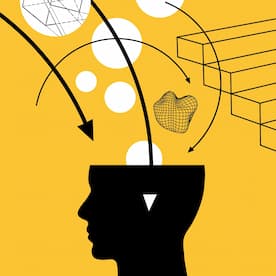
When our brain is exposed to new information it has this innate desire to put it into some type of structure that helps us remember it for the future. Most psychologists refer to this as scaffolding – that when I learn a piece of information it really only is useful to me, I really only remember it, if I know how to fit it into a scaffold of previous things I’ve learned. And when people make decisions, their natural instinct is to look for as close to a binary choice as possible.
So if someone is in a restaurant and they’re trying to order wine and they get handed this huge wine list they’ll go through this process in their head that’s so fast that they might not even recognize what’s going on where they’ll make a series of binary choices. Do I want white or red? I like white. Do I want something that’s from France or from Australia? Well I had French wine last time so that’s better. Do I want something that’s $10 a glass or do I want something that’s $7 a glass? I’d rather get the $7 a glass. This happens so fast that most people don’t understand that they’re making binary decisions. To all of us it just feels like we say, “Oh, I’d like the $7 pinot, please.” But our brain is seeking some way to take a question – a decision – and apply it against the scaffold that already exists inside our head.
And this is really important and useful when we think about how we should teach people new information. Because the more that we help people build scaffolds around new facts and figures or new ideas, the more we’re helping them learn how to use that information in the future.
One of my favorite examples of how this works in the real world is medical school. For years medical school has been built around a basic model which is: See One, Do One, Teach One. Now the reason why medical students have to teach something that they just learned to a fellow student isn’t because they’re great teachers. It’s because once you’ve taught something to someone else, you really understand it. You really remember it.
So when you’re at work and you come across a new idea what you should do is you should try and figure out how do I use this idea? I hear this idea about how to respond to email or how to motivate myself. So I’m going to test that idea. And the first thing that your brain is going to do when you try to test that idea is it’s going to say, “Well where does this fit in the scaffold of what I know about how I motivate myself each morning or how I deal with my emails?” When you begin grappling with information and actually using it – doing something with it – your brain starts putting it into a scaffold that makes it easier to remember down the road and more importantly that helps you learn when you should apply this particular piece of information rather than just sort of blindly drawing what you know out of a huge pool.