 Learning & Development
Develop leaders in your organization with Big Think+ classes
Learning & Development
Develop leaders in your organization with Big Think+ classes
 Custom Content
Create premium thought leadership and storytelling with Big Think Creative
Custom Content
Create premium thought leadership and storytelling with Big Think Creative
 Advertising Campaigns
Reach the smartest audience on the Internet with Big Think editorial integrations
Advertising Campaigns
Reach the smartest audience on the Internet with Big Think editorial integrations
 Live Events
Bring your people and ideas to life with Big Think Events
Live Events
Bring your people and ideas to life with Big Think Events
This content is locked. Please login or become a member.

The Art of Perception: The Four A’s of Visual Intelligence, with Amy Herman, Lawyer, Art Historian, and Author, The Art of Perception
Visual Intelligence
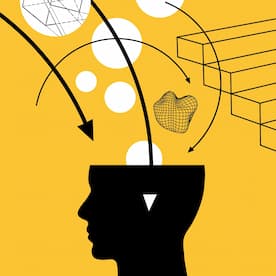
Visual intelligence is the concept that we see more than we can process. And it’s the idea of thinking about what we see, taking in the information and what do we really need to live our lives more purposefully and do our jobs more effectively. We are exposed to different information every day, more than just visual information, sounds and ideas. And it’s always more than our brains can process. The idea of homing in on the skills of how to sort through all the information that we take in, we need to think about those skills consciously and be considerate of them as we’re making bigger decisions in our lives.
There are numerous benefits that range from the nuanced and the very subtle, to big decisions of personal safety. The idea of situational awareness. Knowing where you are at all times, and being able to articulate your physical situation. Where am I? Who’s around me? What’s going on? And then there’s also the idea of long-term situational awareness. What’s going on in my life right now? What are the problems? What are the good things, and how do I articulate those? And these can range from, as I said, ideas of personal safety on the street, on the subway, or understanding your children better, by watching their behavior or their body language or their facial expressions. I think there’s a whole range of applications for visual intelligence that really can enhance, not only the way we live our lives, but how we engage in the world around us.
The model of the four A’s that I describe in the book, and that are a foundation of all of the sessions that I teach in The Art of Perception. It’s a mindset. I work across the professional spectrum. I work with police officers and intelligence analysts and doctors and nurses and librarians. But what’s interesting, for me, is that the four A’s are applicable to all of them. And what they are is, any new situation, any new problem, any new client, any new transaction, any new environment that you’re in, you practice four A’s.
The first one is you assess your situation. What do I have in front of me? What information is here? The second step is to analyze the information. That’s where you break it down and you say, “What’s important? What do I need to prioritize? And what don’t I really have to worry about at all?” And then the third A, I think is actually the most important. It’s how you articulate what you observe. Whether you send an email, whether you pick up the phone, whether you tell a colleague, whether you write it down, the idea of putting into words what your observations are is the most important, because I tell all my groups, I don’t know why this is, but something gets lost from here to here to here. Our brains and our eyes see something, but when it comes to articulating those observations, whether it’s poor choice of words or an inability to communicate effectively, there’s a real loss that I’m trying to redress.
And the fourth A, is after you’ve assessed, analyzed, and articulated what it is that you observe, you adapt your behavior, or you make a decision. Or as I like to say, you act. You take all that information then you make a judgment call based on those three other elements. And I find that that model … I want it to become automatic. I want people to be able to think about assessing, analyzing, articulating, and then making a decision based on all those things.
Visual Intelligence in Practice
One of the best ways to assess a situation, ask someone. This is my situation. Here’s where I am. This is what I see. Is there something here I might be missing? Because by asking someone else, we realize that no two people see anything the same way. Of course, that doesn’t work all the time. But if you’re in an office situation, if you’re in a medical situation and you have the opportunity to collaborate, you’ll get the biggest picture of your assessment if you ask other people what they see as well. And then when you’re analyzing, I find that when you make a mental list in your head … Information I need. Information I might need. And information I definitely don’t need. And for the information that you definitely don’t need, put it away. Because our brains are so cluttered with so much information that if you can, from the outset, get rid of some information, do it.
And then when it comes time to articulate, I ask people to be mindful of every word. Every word counts. And an example that I can give you, that I give in the book, was the investigation of the murder of Chandra Levy in Washington, DC, back in 2001. When the instruction was given to look for her body, the instruction was to look a hundred yards from every trail in the park where she disappeared. But when the instruction was repeated, they said, “Look a hundred yards from every road in the park.” Now the change of one word, from trail to road, changed the whole scope of the investigation. In that third A, in that articulating what you observe, I ask people, be mindful of every word, because someone is listening and every word counts.
And then the fourth A, when you adapt your behavior, I want people to act according to their observations. So if you’re ever questioned about why you made a certain decision … Why did you take a certain road? Why did you solve the problem this way? You’re able to go back to the other A’s and say, well, I thought the situation was this. This was the information I thought was important. I perceive this. Therefore I made this decision. Give yourself the tools to back up the decisions you make, so that when you’re questioned about your decisions, you have all the information you need to make a thoughtful, purposeful, and objective assessment of why you made the decision.
I don’t want to add a burden to what you already have to do. We have enough to do in our lives. What I want to give you is a tool, to have in your tool belt, that becomes an automatic response so that it passes through your mind and you don’t think to yourself, “Okay. A. A. A. Am I doing everything Amy Herman told me to do?” That’s not what I want to do. I want to reset your thought process so that when you arrive at your decisions or you make a judgment call, or you have to act in a difficult situation, you’ve automatically backed it up with your observations and your perceptions. It needs to be automatic. Here I am. This is what I need to do. And this is how I’m going to explain why I need to do this. And I want it to be fast. And I want it to be automatic, because we don’t need to be burdened with more processes and procedures, to be more mindful of the decisions that we make.