 Learning & Development
Develop leaders in your organization with Big Think+ classes
Learning & Development
Develop leaders in your organization with Big Think+ classes
 Custom Content
Create premium thought leadership and storytelling with Big Think Creative
Custom Content
Create premium thought leadership and storytelling with Big Think Creative
 Advertising Campaigns
Reach the smartest audience on the Internet with Big Think editorial integrations
Advertising Campaigns
Reach the smartest audience on the Internet with Big Think editorial integrations
 Live Events
Bring your people and ideas to life with Big Think Events
Live Events
Bring your people and ideas to life with Big Think Events
This content is locked. Please login or become a member.

How to Think Like Sherlock Holmes: The Value of Creativity and Imagination with Maria Konnikova, psychologist
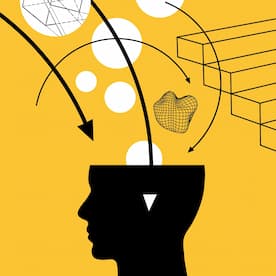
Imagination is an often-ignored part of problem solving. We think that, you know, in order to solve a problem, we just go from point A to point B. We have all the information and we work through it. And that’s definitely true- it is a lot of hard work; you do need to gather the information. You do need to work through it. But one of the things that may actually set you back is if you try to do that just all at once, all in a row, without pausing to really look at what you’ve gathered. It might make it much more difficult to see the big picture. So, you’ll really be lost in the forest. You know, you’ll see all these trees and you’ll have no idea of where you are.
Take a break.
One of the things our brain does is it continues to work on problems subconsciously, even when we’re not consciously working on them. And one of the biggest gifts we can give ourselves when we try to solve a problem is to let that happen, to take some time away and to let your brain do its thing because our conscious and our unconscious processing are two different things and they’re able to see everything in a different light, so we might be able to make connections unconsciously that we wouldn’t make consciously. And it will come to us as this sudden eureka moment, this realization that, oh, my God, you know, this is actually the solution. But it’s not – I think that it calling it a eureka moment is also a little bit of a misnomer because you’ve been working on it the whole time. It doesn’t come from nowhere.
It comes from somewhere incredibly specific, which is all the information that you’ve already gathered, percolating in your mind, mixing with all of the contents of your brain attic, and your brain is working on this feverishly, even if you’re not aware of it. And so what you can do is relax and let it do its thing. Holmes does this all the time. I call it the three-pipe problem from the Adventure of the Red Headed League where he – a client comes in and asks him about this very strange job offer. He’s given him a job just because he has hair of a particular red color. And Holmes says, “It’s a three-pipe problem. I’m just going to sit here and smoke three pipes and think about this.” And this is the time where his imagination can really get to work and where he can really be creative and think through all of the possibilities that he would never even imagine and he would never even realize are possibilities if he hadn’t taken those three pipes to think about them.
Manipulate your consciousness.
One of the ways that we can create distance is through kind of manipulating our consciousness in a very natural way, which is going to sleep. That is the single biggest change of consciousness we have on a day-to-day basis. And a lot of times insights and the ability to solve a problem will come at two specific points—as you’re falling asleep and as you’re waking up. And the reason is that your brain is relaxing, which allows a default mode network to access connections that it otherwise wouldn’t be able to see. Because all this time it’s just searching, searching, searching, saying, okay, is there anything that’s salient? Are there any cues that I can latch on to? And as you become more relaxed, you’re able to see things that you wouldn’t.
Those two transitional stages where you’re just falling asleep, when you’re just waking up, when your consciousness is transitioning from wake to sleep or sleep to wake, those can be incredibly insightful moments, moments when you see things, when you solve problems that you wouldn’t otherwise be able to solve. That’s why one of the things that so many people recommend is to keep paper or a diary or something by your bed because, if you don’t write it down, you’ll probably forget it because you’ll fall asleep or you’ll go take a shower. You’ll forget what it was that you wanted to write.