 Learning & Development
Develop leaders in your organization with Big Think+ classes
Learning & Development
Develop leaders in your organization with Big Think+ classes
 Custom Content
Create premium thought leadership and storytelling with Big Think Creative
Custom Content
Create premium thought leadership and storytelling with Big Think Creative
 Advertising Campaigns
Reach the smartest audience on the Internet with Big Think editorial integrations
Advertising Campaigns
Reach the smartest audience on the Internet with Big Think editorial integrations
 Live Events
Bring your people and ideas to life with Big Think Events
Live Events
Bring your people and ideas to life with Big Think Events
This content is locked. Please login or become a member.

How to Think Like Sherlock Holmes: Understand the Brain Attic, with Maria Konnikova, Author, Mastermind: How to Think Like Sherlock Holmes
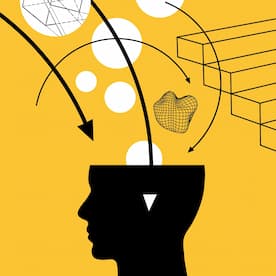
Our brain attic is our mind and it’s how we store and process information. Everyone’s attic is different. There’s a lot of individual difference with the brain attics, but there are certain principles that tie all brain attics together.
Get to know the content and structure of your mind
We all come with our own experience so every brain attic is almost pre-programmed to take in certain information because we’ve been – we think it’s interesting, we find it applicable, we enjoy it. These are things that are relevant to us whether not we realize it. You know, sometimes you’ll realize that you just remember the most random facts, and you’ll say, you know, “I don’t know how I remember it.” You remember it because your brain attic somehow thought that this would be useful to you. But normally you don’t control it. All of these things just come in like clutter. It’s like someone going to a junkyard, to a flea market, and saying, ”Oh, this looks cool. Oh, that looks cool. I’m going to take all of this because I have a huge house. I’ll be able to put all this stuff anywhere I want.” Then you throw it up there and, yeah, your attic was really big and it had lots of windows, and you thought you could fit anything you wanted up there, but one day you walk up there and it all starts falling on you. You can’t find anything. And you say, ”Oh, I think I remember; I went to that flea market and I bought this wonderful blue – I don’t remember what it was. Where is it?” And you go up there and it’s nowhere to be found because you just kind of tossed it up there. That’s our System Watson brain attic; that’s how we normally take in information.
What Holmes says is that isn’t acceptable. Our memory can be our friend if we work with it, if we teach it to remember those things that actually matter and if we learn to organize or encode our memories properly. So to take the brain attic, Holmes would never just toss something up there. Right before it would come in, he would say, “Wait, hold on. What is this? Why are we putting this in here? Do I want to put it in here or do I not want to put it in here?” So he actually takes this short and long-term memory storage very seriously. He says, “Do I want this to go into my long-term memory or is it something that I’m going to do my best to forget?” Like he says about the Copernican theory. “Yes, now I know that Copernicus discovered all this stuff about the solar system. I’m going to do my best to forget it.” He wants to show you, look, even something that might seem important to someone else, might not be important to you.
Encoding skill
So then how do you store it once you’ve identified what is actually important to you? Memory works in a fascinating way, I think, and we’re learning more and more about how we can optimize our memory to – so that the attic doesn’t stay static, so that we can actually expand the space, so that what used to be a small attic can suddenly become much more spacious because we are using the space more efficiently. The more that we encode something, the more sensory inputs there are with it, and the more basic knowledge we have, that we can tie to that thing that we’re encoding. So the more that we already have in our attic, that we can relate to that new piece of information, the better we’ll be able to recall it. Anything that we could use to tag it will be something that we can use to retrieve it.
Is there a smell that you can associate with the memory? Is there a touch? Is there a sound? Is there a time of day? Is there a feeling? What is it that sets this apart? And then does it somehow relate to something that’s already in your attic? Is there a folder where you can put it that already has similar items? Can you cross-reference it? Maybe this folder actually fits into two different boxes? Maybe they are different tags that you can put on it?
The more that we’re able to do that, the more that we’re able to have these cross-references—you know, think of it as a giant Library of Congress, where we’re really trying to put as many tags on it as possible– the more likely it is that we’ll remember it when the time comes and that we’ll be able to use it when we need to.