 Learning & Development
Develop leaders in your organization with Big Think+ classes
Learning & Development
Develop leaders in your organization with Big Think+ classes
 Custom Content
Create premium thought leadership and storytelling with Big Think Creative
Custom Content
Create premium thought leadership and storytelling with Big Think Creative
 Advertising Campaigns
Reach the smartest audience on the Internet with Big Think editorial integrations
Advertising Campaigns
Reach the smartest audience on the Internet with Big Think editorial integrations
 Live Events
Bring your people and ideas to life with Big Think Events
Live Events
Bring your people and ideas to life with Big Think Events
This content is locked. Please login or become a member.
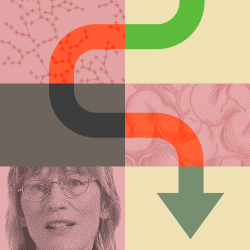
Breaking Through Learning Obstacles: Get Unstuck from a Thinking Rut, with Barbara Oakley, Professor of Engineering, Oakland University, and Author, Mindshift
It turns out that it’s all too easy for us to fall into a sort of rut in our thinking and it can feel so comfortable, so good. We can feel so certain that it’s right that we can’t even realize that we’re stuck in a rut. Part of this is called Einstellung, right, this kind of effect. You see one approach to do things and you are convinced it’s right. And even it if isn’t the best approach you just can’t see other approaches because you’ve already locked in that first approach. To some extent we do that in everything we do in life because as we grow, as we grow from infants – our earliest years we have lots of synaptic connections. And as we don’t use some of them they just wither away and die. So even by six months of age what happens is, you’ve lost the ability to even hear certain sounds of other languages because you haven’t actually used those circuits yourself. So what you want to do in your life is you want to try to expose yourself to novel stimuli as much as possible. That doesn’t mean that you have to like live a topsy turvy life but try things like sitting at a different place at the dinner table or brush your teeth with the other hand. And, of course travel is a great way of getting out of your comfort zone.
One of the things that I think is very interesting is Nobel Prize-winner Ramon y Cajal – he’s considered the father of modern neuroscience. And he’d worked with many geniuses. And he said, you know, I’ve worked with these geniuses and he said, “I am not a genius.” He said what I am is persistent and I’m flexible when I see that the data is telling me something different than I thought it should tell me. So he was able to change his mind. Now what happens with really smart people, those geniuses who Ramon y Cajal was referring to is they’re super smart. So they’re used to being right and figuring things out quickly. They tend to jump to conclusions and they haven’t had the experience of changing their minds when they’re wrong because they haven’t been wrong that often. And what that does is that makes them less flexible in the face of changing data or even being more open to different ideas.
It’s really important to try to keep yourself flexible, try to talk to people of different opinions, listen to them. Of course you’ll be forming your own opinions but you’ll be surprised if you listen carefully how you can find yourself being a more open and caring person just for the fact that you’ve listened.