 Learning & Development
Develop leaders in your organization with Big Think+ classes
Learning & Development
Develop leaders in your organization with Big Think+ classes
 Custom Content
Create premium thought leadership and storytelling with Big Think Creative
Custom Content
Create premium thought leadership and storytelling with Big Think Creative
 Advertising Campaigns
Reach the smartest audience on the Internet with Big Think editorial integrations
Advertising Campaigns
Reach the smartest audience on the Internet with Big Think editorial integrations
 Live Events
Bring your people and ideas to life with Big Think Events
Live Events
Bring your people and ideas to life with Big Think Events
This content is locked. Please login or become a member.
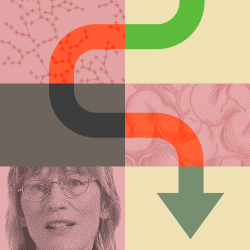
Breaking Through Learning Obstacles: Onboard New Concepts with Metaphor, with Barbara Oakley, Professor of Engineering, Oakland University, and Author, Mindshift
When you know something in one area you can bring creative new approaches to the second area even if they seem completely different. And how this happens is through metaphor. When you learn something in one area you create neural patterns in your mind. And these patterns can inform and help create new patterns in a completely different subject area.
When I worked on the book A Mind for Numbers I went to a website called RateMyProfessors.com. And, of course, that gives you insight into who the very best professors are in any given discipline. And I downloaded the top 200 to 300 professors in disciplines like chemistry, mathematics, physics, English, all sorts of disciplines. And I found their emails and I emailed thousands of these professors and I asked them: Would you be willing to take a look at my manuscript on learning effectively? To my shock a vast percentage of these individuals responded favorably. And they looked at my manuscript, gave some great insights. But here’s one of the most interesting things that they told me. Some of these incredible teachers, a lot of them, used metaphor as one of the ways they conveyed key ideas. And that’s why they were top teachers. But they were reluctant to share the fact that they used metaphor because other teachers, other professors, would put them down for doing it. They’d say oh, you’re dumbing down the material instead of what is really happening as we know from neuroscience when you use a metaphor to first introduce an idea that creates a neural pattern that is the same neural pattern – it basically builds on the neural pattern that you would need to be able to understand the deep underlying concept itself. This is called neural reuse theory.
Through metaphor then you can more rapidly onboard people onto very difficult ideas. If you’re trying to teach the idea of a limit in calculus. Well it’s a little bit like a stalker that’s getting closer and closer but never quite getting to where – and once you teach that idea that starts making the idea of a limit seem oh, that’s more concrete and understandable and it’s sort of a weird image. And weird images actually help your memory. So going back to things – we know we learn through metaphor, if you learn in one subject you will through metaphors be able to apply those ideas to a completely different subject and that helps build creativity. So if you’re learning investment let’s say, while you’re reading these books on investments everybody else who’s learning about investments is reading the same books. But if you do a little side reading on something completely different, let’s say horse racing in the 1930s, you through metaphor can bring forth great new ideas that other people do not have. So learning a little bit or a lot in a second subject or other subjects can be invaluable in helping you be creative in the original subject.