 Learning & Development
Develop leaders in your organization with Big Think+ classes
Learning & Development
Develop leaders in your organization with Big Think+ classes
 Custom Content
Create premium thought leadership and storytelling with Big Think Creative
Custom Content
Create premium thought leadership and storytelling with Big Think Creative
 Advertising Campaigns
Reach the smartest audience on the Internet with Big Think editorial integrations
Advertising Campaigns
Reach the smartest audience on the Internet with Big Think editorial integrations
 Live Events
Bring your people and ideas to life with Big Think Events
Live Events
Bring your people and ideas to life with Big Think Events
This content is locked. Please login or become a member.
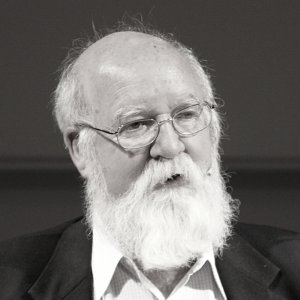


If consciousness is ours to give, should we give it to AI? This is the question on the mind of the very sentient Daniel Dennett. The emerging trend in AI and AGI is to humanize our robot creations: they look ever more like us, emote as we do, and even imitate our flaws through machine learning. None of this makes the AI smarter, only more marketable. Dennett suggests remembering what AIs are: tools and systems built to organize our information and streamline our societies. He has no hesitation in saying that they are slaves built for us, and we can treat them as such because they have no feelings. If we eventually understand consciousness enough to install it into a robot, it would be unwise. It won't make them more intelligent, he says, only more anxious. Daniel Dennett's most recent book is From Bacteria to Bach and Back: The Evolution of Minds.
https://s3.amazonaws.com/edge-misc-assets/Book+Covers/Daniel+Dennett.jpg" width="225" height="150">
Daniel C. Dennett: I think a lot of people just assume that the way to make AIs more intelligent is to make them more human. But I think that's a very dubious assumption.
We're much better off with tools than with colleagues. We can make tools that are smart as the dickens, and use them and understand what their limitations are without giving them ulterior motives, purposes, a drive to exist and to compete and to beat the others. those are features that don't play any crucial role in the competences of artificial intelligence. So for heaven sakes don't bother putting them in.
Leave all that out, and what we have is very smart “thingies” that we can treat like slaves, and it's quite all right to treat them as slaves because they don't have feelings, they're not conscious. You can turn them off; you can tear them apart the same way you can with an automobile and that's the way we should keep it.
Now that we're in the age of intelligent design—lots of intelligent designers around—a lot of them are intelligent enough to realize that Orgel's Second Rule is true: "Evolution is cleverer than you are." That's Francis Crick’s famous quip. And so what they're doing is harnessing evolutionary processes to do the heavy lifting without human help. So we have all these deep learning systems and they come in varieties. There's Bayesian networks and reinforcement learning of various sorts, deep learning neural networks… And what these computer systems have in common is that they are competent without comprehension. Google translate doesn't know what it's talking about when it translates a bit of Turkish into a bit of English. It doesn't have to. It's not as good as the translation that a bilingual can do, but it's good enough for most purposes.
And what's happening in many fields in this new wave of AI is the creation of systems, black boxes, where you know that the probability of getting the right answer is very high; they are extremely good, they're better than human beings at churning through the data and coming up with the right answer. But they don't understand how they do it. Nobody understands in detail how they do it and nobody has to.
So we've created entities, which are as inscrutable to us as a bird or a mammal considered as a collection of cells is includable; there's still a lot we don't understand about what makes them tick.
But these entities instead of being excellent flyers or fish catchers or whatever they're excellent pattern detectors, excellent statistical analysts, and we can use these products, these intellectual products without knowing quite how they're generated but knowing having good responsible reasons for believing that they will generate the truth most of the time.
No existing computer system no matter how good it is at answering questions like Watson on Jeopardy or categorizing pictures, for instance, no such system is conscious today, not close. And although I think it's possible in principle to make a conscious android, a conscious robot, I don't think it's desirable; I don't think there would be great benefits to doing this; and there would be some significant harms and dangers too.
You could at tremendous expense, but you'd have to have in fact quite a revolution in computer design, which would take you right down to the very base of the hardware.